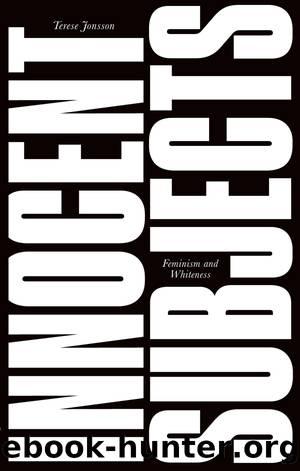
Innocent Subjects: Feminism and Whiteness by Jonsson Terese
Author:Jonsson, Terese [Jonsson, Terese]
Language: eng
Format: epub
Publisher: Pluto Press
Published: 2020-12-19T16:00:00+00:00
An extended footnote accompanies this paragraph. This starts by pointing out that the ârelationship between Islam and feminismâ and âthe migrant crisisâ are âdifferent issues, even though they are often conflated by the mainstream pressâ. Chamberlain goes on to highlight right-wing media constructions of âan influx of non-refugeesâ bringing âreligions and cultures that marginalise and subordinate womenâ. Chamberlain problematises such constructions, but then brings in the issues of âforced marriage and honour-based abuseâ and describes the âproblematic of gender, religion and cultureâ as having been âexarcerbated by incidents of mass sexual assault in European cities as well as reports of abuse in migrant centres, allegedly perpetuated by migrantsâ. The footnote concludes by pointing out that such incidents have led to âright-wing politicians using feminism as a means by which to justify xenophobia and exclusionary politicsâ. 48
These two paragraphs take the reader through a whirlwind of complex and contentious topics, none of which are fully elaborated. While the discussion importantly signals concern with how racism shapes public debates about migration, âIslam and feminismâ, and sexual assault, and while it draws attention to problematic conflations between these various topics, the quick gallop through them creates its own conflations and slippages. For one, there is an assumption that there is an obvious relationship between these various issues that does not need to be explained. This reproduces what Ahmed describes as a âstickinessâ between them. In analysing the proximity constructed between âthe figures of the asylum seeker and the international terroristâ within government discourse, Ahmed draws attention to the way âemotions work by sticking figures together (adherence), a sticking that creates the very effect of a collective (coherence)â (Chamberlain herself draws on this concept in other parts of the book). 49 According to Ahmed, the frequent âstickingâ of words such as âIslamâ and âterroristâ and âasylum seekerâ in close proximity naturalises a connection between them, creating a figure of collective fear. She notes that this connection does not have to be explicitly made; it is rather the repeated proximity of certain signs, words and objects that creates the links.
In relation to gender, Naaz Rashidâs research on policy discourse about Muslim women similarly highlights how topics such as veiling, forced marriage and FGM are frequently positioned on a continuum with âextremismâ and terrorism within Muslim communities, despite the connection between such topics being unclear and unevidenced. She ascribes this âconflation of what are conceptually distinctive policy concernsâ to the âsecuritisation of the policy landscapeâ, which folds all âsocial problemsâ associated with Muslims together in highly problematic and reductive ways. 50 The fact that Chamberlain simultaneously highlights increased levels of racism, then, does not undo the affective lumping together of the topics of âextremismâ, âFGMâ, âIslamâ, âthe veilâ, âmigrant crisisâ and âmass sexual assaultâ. These all become potent signifiers for what is referred to as âthe difficulty of Britainâs multicultural societyâ. This framing relies on the dominant contemporary public discourse which repeatedly constructs âMuslimsâ as a problem for Europe and âthe Westâ. 51 While framing the
Download
This site does not store any files on its server. We only index and link to content provided by other sites. Please contact the content providers to delete copyright contents if any and email us, we'll remove relevant links or contents immediately.
| Anthropology | Archaeology |
| Philosophy | Politics & Government |
| Social Sciences | Sociology |
| Women's Studies |
Cecilia; Or, Memoirs of an Heiress — Volume 1 by Fanny Burney(32558)
The Great Music City by Andrea Baker(32018)
Cecilia; Or, Memoirs of an Heiress — Volume 2 by Fanny Burney(31956)
Cecilia; Or, Memoirs of an Heiress — Volume 3 by Fanny Burney(31941)
We're Going to Need More Wine by Gabrielle Union(19046)
All the Missing Girls by Megan Miranda(16023)
Pimp by Iceberg Slim(14506)
For the Love of Europe by Rick Steves(14121)
Bombshells: Glamour Girls of a Lifetime by Sullivan Steve(14073)
Talking to Strangers by Malcolm Gladwell(13370)
Norse Mythology by Gaiman Neil(13363)
Fifty Shades Freed by E L James(13239)
Mindhunter: Inside the FBI's Elite Serial Crime Unit by John E. Douglas & Mark Olshaker(9339)
Crazy Rich Asians by Kevin Kwan(9290)
The Lost Art of Listening by Michael P. Nichols(7506)
Enlightenment Now: The Case for Reason, Science, Humanism, and Progress by Steven Pinker(7311)
The Four Agreements by Don Miguel Ruiz(6763)
Bad Blood by John Carreyrou(6621)
Weapons of Math Destruction by Cathy O'Neil(6279)
